
Most composite decking manufacturers recommend either 12″ or 16″ on-center spacing, but there’s more to it than just picking a number.
If you’re planning to build or renovate a deck, this article covers the required joist spacing for composite decking, when to add extra support, and how to avoid mistakes that’ll cost you down the line.
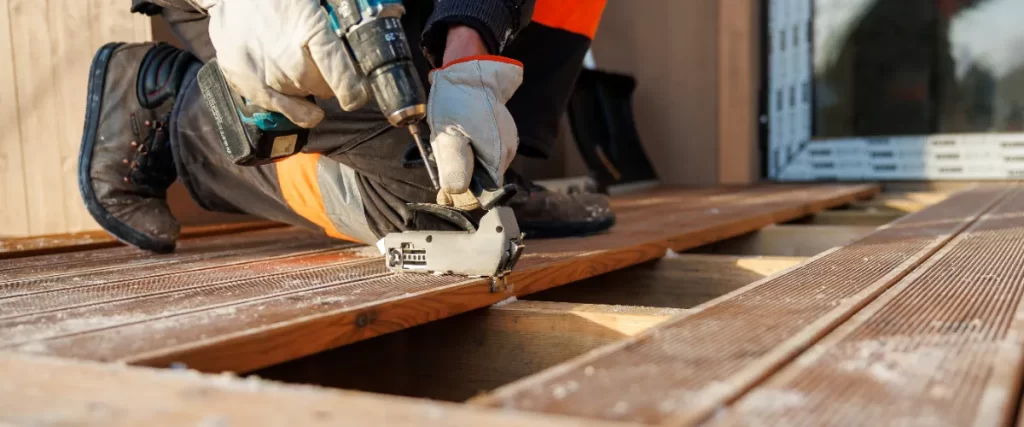
Why Joist Spacing Matters More With Composite Than Wood
Because composite deck boards are denser and more flexible than traditional wood, they’re more sensitive to the gaps between joists below them.
A soft spot in the middle of a board, or boards that wave and dip across the surface, almost always traces back to incorrect joist spacing.
Most manufacturers, including Trex, specify a maximum of 16 on-center for straight decking runs.
Want to go diagonal or picture-frame the border? You’ll need additional framing support. That’s the requirement to keep your warranty valid.
Standard Spacing Rules to Know Before You Start
Here’s a quick reference that covers the most common scenarios:
| Decking Pattern | Recommended Joist Spacing |
|---|---|
| Straight (perpendicular to joists) | 16″ on center |
| Diagonal (45° angle) | 12″ on center |
| Picture frame/border | 16″ on center + blocking required under border boards* |
| Heavy foot traffic areas | 12″ on center recommended |
*Some manufacturers or commercial applications may require 12″ on center for picture-frame installations. Always confirm with your specific product’s installation guide.
Note that your local building codes may have their own requirements that differ from the manufacturer’s guidelines. Always check with your municipality or a licensed inspector before finalizing the frame design.
The International Code Council publishes model codes that many jurisdictions adopt, which is a solid starting point for understanding what’s typically required structurally.
Setting Up the Deck Frame

Start With the Ledger Board and Rim Joist
The ledger board attaches to the house wall and anchors the whole frame. It needs to be perfectly level because everything downstream, including your joist locations, depends on it. The rim joist runs along the outer edge of the deck and closes the frame on the far end.
Once both are secured, you can start laying out where all the joists go.
Marking Joist Locations
Snap a chalk line at your first joist location, then measure from that line rather than from the rim board repeatedly.
Small measurement errors stack up fast when you’re spacing 10 or 12 joists across a large deck. Run string lines across the frame to double-check that your marks stay true.
Joist hangers connect each joist to the ledger board and rim joist. They’re non-negotiable for a structurally sound deck. Nail or screw them in before setting the joists, not after.
When You Need to Add or Modify Joists
Working With an Existing Frame
If you’re replacing wood decking with composite on an existing frame, the first thing to do is check whether your existing joists are spaced correctly for the new material.
Walk the deck carefully and feel for low spots or soft spots. Those are red flags.
A few things to look at:
- Are the existing joists at 16″ on center or tighter?
- Is there any rot or damage in the rim joist or ledger board?
- Do any spans exceed the limits set by the composite manufacturer?
If the spacing is too wide, you don’t have to tear everything down. Sister joists can be added alongside existing joists to tighten the spacing. It’s more work, but it’s much cheaper than a full rebuild.
Adding a Couple of Extra Joists for Diagonal Runs
Going diagonal is one of the most popular visual upgrades homeowners make. The boards look great at a 45° angle, but the frame has to support them.
Because diagonal boards cross each joist at an angle, the unsupported span between joists is effectively longer. That’s why the required joist spacing drops to 12″ on center.
Plan for this before you build the frame. Adding a couple of extra joists during initial construction is easy, but adding them after the decking is laid is not.
Common Installation Mistakes (and How to Avoid Them)
- Skipping blocking at seams. Where two boards meet end-to-end, there needs to be enough width to fasten both ends properly. Blocking is required at these locations to prevent you from trying to nail into thin air.
- Ignoring the rim board width. The rim joist needs to be wide enough to support the last board fully. If it’s undersized, the edge of the deck will flex.
- Not accounting for diagonal cuts. When boards run at an angle, small pieces get left at the edges. A circular saw with a good composite blade handles these cuts cleanly. A power sander cleans up any rough edges after.
- Trusting the existing frame without verifying. Always run string lines and check that all the joists are equally spaced and sitting at the same height. Even one joist that’s a little high will create a ridge you’ll feel every time you walk over it.
Fasteners, Screws, and How Boards Attach
Composite decking uses either hidden fasteners or face screws, depending on the product.
Hidden fasteners clip into the grooves along the board edges, providing a clean surface with no visible hardware. Face screws go straight through the top of the board.
Both work well, but hidden fasteners require a bit more precision at the joist layout stage, since the clip must land on the joist to fasten properly. If your joists are even slightly off, the clips won’t seat properly.
Stair stringers actually need tighter spacing than your field joists. Most composite manufacturers require 12″ OC or less for stair treads, and some spec as tight as 9″ OC.
Always check your manufacturer’s stair-specific guidelines before framing, because composite treads flex more under concentrated foot traffic than the main deck surface does.
FAQ
What is the standard joist spacing for composite decking?
Most composite decking products require joists spaced 16″ on center for straight installations and 12″ on center for diagonal or picture-frame patterns. Always confirm with your specific manufacturer’s installation guide.
Can I install composite decking over existing joists?
Yes, if the existing joists meet the required spacing and are structurally sound. Inspect for rot, verify the spacing, and add sister joists if needed before laying new composite boards.
Does joist size affect composite deck performance?
Joist size affects span capacity more than the boards’ surface performance. Larger joists allow longer spans between beams. Your local building code will specify minimum joist sizes based on the deck’s dimensions.
Do I need blocking for composite decking?
Blocking is required wherever board ends meet over a joist to ensure both ends can be properly fastened. Some manufacturers also require blocking at specific intervals along the run, depending on board length.
What happens if joist spacing is too wide?
The boards will flex and potentially bounce underfoot. Over time, this can cause fasteners to loosen, seams to open up, and in worst cases, boards to crack or bow. It also typically voids the manufacturer’s warranty.
Is 24″ joist spacing okay for composite decking?
No. The vast majority of composite decking manufacturers do not allow 24″ on center spacing. This is a common framing standard for subfloors and floor joists in home construction, but it creates too much flex for composite deck boards.
Let The Pros Handle It
It’s clear there’s a lot to manage: spacing requirements, blocking, joist hangers, diagonal adjustments, existing frame inspections, and local code compliance. Each of those steps has its own set of variables, and one mistake can affect the entire deck surface.
If you’re based in the Whitestown, Indiana area, our team at Decks On Point can handle all of this for you, from frame layout to final fastener. We know composite decking inside and out, and we take the guesswork completely off your plate.
Call us at (317) 903-2431 or message us here to talk through your project.