
Your deck acts as the bridge between the comfort of your home and the freedom of the outdoors. The stairs that connect these two spaces often get overlooked as a simple functional necessity. You need a way to get down to the grass. However, the design of your deck stairs can completely change the look and feel of your backyard.
We believe the stairway offers a unique opportunity to add style and personality to your project. It dictates the flow of traffic and influences how people interact with the space. A well-designed staircase serves as an invitation. It draws the eye and welcomes guests into your outdoor living space.
Here are ten creative deck step ideas that range from traditional to modern. We have included rough cost estimations to help you plan your budget. Keep in mind that labor, material availability, and local building codes will always influence the final price.
1. The Wide “Grand” Staircase
Standard stairs are usually about three or four feet wide. Widening that opening creates a dramatic effect. A staircase that spans six, eight, or even ten feet opens up the deck to the yard. This seamless transition makes the deck feel less like a cage and more like a true extension of the lawn.
This design serves a dual purpose. The wide treads act as casual seating during parties. People naturally gravitate toward the edge of the deck to sit and chat. Wide steps provide plenty of room for this without blocking the path for others walking up or down.
- Cost Estimation: High. This option requires significantly more materials for framing and decking. You also need a wider concrete landing pad. Expect to pay 50% to 70% more than a standard staircase due to the volume of lumber and labor.
2. Space-Saving Spiral Stairs
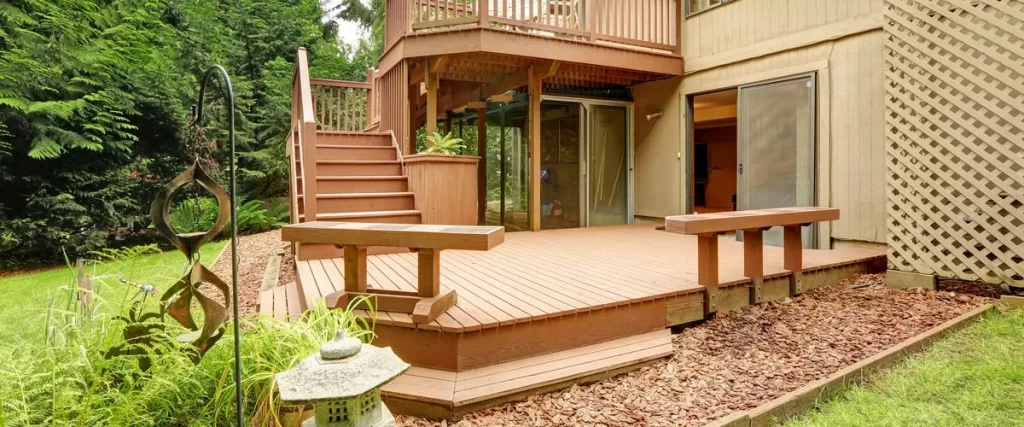
Spiral stairs are a fantastic solution when you have a high deck but a small backyard. A traditional long staircase eats up a lot of usable lawn space. A spiral staircase keeps the footprint tight and compact.
These staircases add a touch of elegance and architectural interest. They often come in metal kits, which you can customize with wood treads to match your deck boards. The vertical lines of a spiral stair draw the eye upward and work well with contemporary or industrial home designs.
- Cost Estimation: Medium to High. Metal kits can range from $2,000 to $6,00,0 depending on the height and finish. Custom-built wooden spiral stairs are labor-intensive and will sit at the higher end of the price spectrum.
3. Cascading Wraparound Steps
If your deck is low to the ground, wraparound steps are a beautiful choice. These steps run along the entire perimeter or a significant portion of the deck edge. They create a tiered effect that looks like a waterfall of wood or composite decking.
This style eliminates the need for a railing in many cases, provided the deck height is below the requirement set by local building codes. It creates a very open and accessible feel. You can step off the deck in any direction.
- Cost Estimation: Medium. While you save money on railings, you spend more on the substructure. You have to build box frames around the entire perimeter. The cost is generally balanced but labor-intensive.
4. Steps with Built-In Lighting
Safety is an important consideration for any outdoor structure. Integrating lights into the steps ensures you can navigate the stairs safely at night. It also looks incredible.
You can install small LED riser lights that shine down on the tread below. Alternatively, you can route channels under the nosing of the tread for strip lighting. This creates a glowing, floating effect for each step. This lighting sets a mood and extends the usability of your deck into the late evening.
- Cost Estimation: Low to Medium (Add-on). The lights themselves are relatively affordable. The cost comes from the electrical work and the time required to hide the wiring during construction. Expect to add $20 to $40 per step for quality fixtures and installation.
5. Mixed Materials for Texture
You do not have to build your stairs out of the same material as the deck. Using stone or masonry for the stairs creates a solid and grounded feeling. You can build a stone base and top it with wood treads to tie it back to the deck design.
This works particularly well for landings or the first few steps leading up from a patio. The contrast between the warm wood and the cool stone adds depth and visual interest to the design.
- Cost Estimation: High. Masonry work is generally more expensive than carpentry. You are paying for specialized labor and heavy materials like stone veneer or poured concrete.
6. The Multi-Level Landing

Long staircases can look imposing and tiring. Breaking them up with landings makes the climb easier. A landing changes the direction of the stairs, which creates a more interesting visual flow.
You can make the landing large enough to hold a bench or a couple of potted plants. This turns a transition space into a small destination of its own. It softens the look of a second-story deck and reduces the “fire escape” appearance.
- Cost Estimation: Medium. You are essentially building a mini-deck in the middle of your stairs. This requires additional footings and posts, increasing the material and labor cost by about 20% to 30% over a straight run.
7. Curved Steps
Curved steps soften the sharp angles of a rectangular deck. They add a sophisticated and custom look that stands out. The gentle arc of the stairs invites you into the yard with a graceful flow.
Building curved steps requires a high level of skill. The framing must be precise. If you use composite decking, the boards often need to be heated and bent to match the radius. This is a showstopper feature that impresses anyone who visits.
- Cost Estimation: Very High. This is one of the most expensive options due to the labor involved. It takes experienced designers and carpenters to execute this correctly.
8. Modern Floating Stairs
Floating stairs have a sleek and minimalist appearance. They usually consist of thick treads supported by a central stringer or hidden brackets. The risers are left open, allowing you to see through the stairs to the landscaping behind.
This style looks amazing on modern homes. It keeps the outdoor space feeling airy and light. However, you must check building codes carefully regarding open risers to ensure safety compliance for children and pets.
- Cost Estimation: High. You often need structural steel stringers to support the treads without visible framing. Thick timber or specialized composite treads also cost more than standard boards.
9. Integrated Planter Boxes
You can frame the staircase with built-in planter boxes. This brings greenery right up to the steps and helps blend the structure with the garden.
The planters can serve as the guardrail for low stairs. You can fill them with colorful flowers or aromatic herbs. This adds life and color to the wood or grey tones of the deck materials.
- Cost Estimation: Medium. This involves extra framing and finishing materials. You also need to line the boxes properly to prevent water damage to the wood.
10. Contrasting Colors
You can achieve a custom look simply by playing with color options. Use a dark color for the treads and white for the risers. This classic look mimics the interior trim of many traditional homes.
Alternatively, you can match the risers to the railing color and the treads to the deck floor. This visual distinction helps people see the edge of each step clearly, which improves safety.
- Cost Estimation: Low. This is purely a design choice. It costs the same to buy two different colors of stain or composite boards. It adds significant style for zero extra dollars.
Navigating Building Codes and Safety
We cannot talk about stairs without mentioning safety. Steps are the most regulated part of a deck build for a reason. Local building codes dictate specific measurements for the rise (height) and run (depth) of each step.
Usually, the rise must be around 7.75 inches maximum, and the tread depth should be at least 10 inches. These rules ensure that the stairs are comfortable to walk on and prevent tripping hazards.
You also need to consider graspable handrails. If you have four or more risers, a handrail is usually required. The inspector will check these measurements strictly. A beautiful staircase is useless if it fails inspection or feels awkward to walk down.
Maintenance Considerations
The material you choose affects your long-term maintenance. Wood steps will need annual sealing or staining to handle the foot traffic. The grit from shoes acts like sandpaper on the finish.
Composite materials are more durable and resist scratching and fading. Since stairs see the most abuse of any part of the deck, investing in high-quality decking for the treads is a smart move. You want materials that provide grip even when wet.
Planning Your Project
When you start planning your new deck, think about the stairs early in the process. Don’t leave them as an afterthought. Consider how the sun hits the yard. Think about where you park your car or where the kids play.
The location of the stairs determines the traffic pattern. You want a natural flow that leads people to the destination without forcing them to squeeze past furniture.
Designers often suggest exploring a few different configurations. Sketch out a straight run, a landing turn, or a flared bottom. See what fits the scale of your house.
Why You Should Hire a Pro
Building stairs is technically difficult. It requires precise math. If you cut a stringer incorrectly, the whole staircase will be uneven. This results in steps that feel “bouncy” or awkward.
There is also the matter of the landing pad. You need a solid concrete base at the bottom of the stairs. This prevents the stairs from sinking into the mud over time.
While DIY projects are fun, stairs carry a higher risk. A mistake here is a safety hazard. You want your family to be safe. You want the finish to look professional and polished.
Understanding the complexity of layouts, materials, and code requirements is part of professional deck building. You ensure your project stands the test of time when you rely on experience.
If you would rather skip the headache of calculating rise-and-run ratios and digging concrete footings in the dirt, we are ready to help you out. Let’s get your backyard looking fantastic. Call us at (317) 903-2431 or message us here.