
The best composite deck colors for 2026 are leaning hard into nature.
Warm browns are back at the top of the charts, earthy neutrals are taking over from the clean-slate grays of the past decade, and multi-tonal boards that genuinely mimic natural wood grain are everywhere.
This article covers the dominant color trends, the specific shades worth knowing by name, and how to match a deck color to your home’s style, siding, and yard.
An Overview of 2026’s Decking Color Trends
For several years, cool gray dominated. It was the go-to for modern homes, and honestly, it still looks great. But heading into 2026, something bigger is happening. Homeowners are choosing colors that feel connected to the landscape rather than layered on top of it.
Rich browns, earthy tones, and shades that blend naturally into surrounding trees and garden beds are dominating outdoor spaces.
This is connected to a broader design movement called biophilic design, which is really just the idea that people feel calmer and more at home in spaces that echo the natural world.
A deck that reads as a natural extension of your yard tends to feel intentional in a way that a flat color rarely does.
That doesn’t mean gray is gone. It’s evolved, moving away from single-tone slabs toward weathered, textured versions with warm or cool undertones that feel much more organic.
1. Rich Browns
Browns are clear frontrunners this year. TimberTech’s color palette reflects this well, with options across the spectrum from warmer mid-tones all the way to deep, moody shades that bring real presence to a deck.
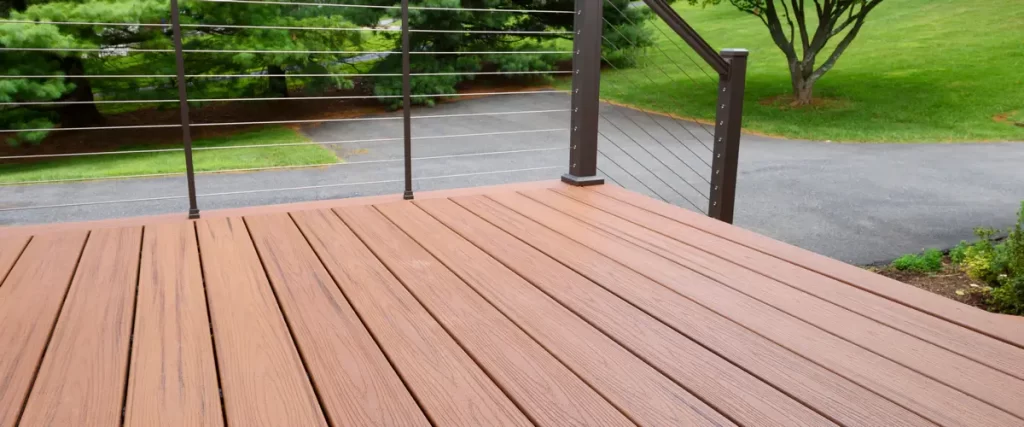
A few standouts from TimberTech’s brown collection:
- Mahogany (Vintage Collection): Deep, warm, with high color blending that gives it genuine visual depth. It pairs especially well with stone accents and dark aluminum railing systems.
- English Walnut (Vintage Collection): A mid-tone brown with subtle striping, ideal for decks that need to complement wooded backyards without competing with the landscape.
- Dark Cocoa (Prime+ Collection): Rich and warm-toned. Works really well on expansive surfaces where a flat color might start to feel monotonous.
- Espresso (Legacy Collection): One of the most popular decking shades for homeowners who want bold contrast against lighter siding. Dark, saturated, and very current.
Worth knowing: the darker the color, the more heat it will hold underfoot on sunny days. This matters in places with hot summers, so it’s worth factoring in before you fall in love with an espresso-toned deck.
2. Cool Grays
Gray hasn’t stepped aside. It’s just gotten more nuanced. The versions trending now aren’t the clean, flat grays of a few years back. Think weathered driftwood, soft greys with warm undertones, and shades that feel more like coastal silver than a modern tile floor.

TimberTech’s gray family delivers well here:
- Coastline (Vintage Collection) is a rich, dimensional shade with cool undertones that reads beautifully in contemporary spaces.
- Driftwood (Reserve Collection) leans more neutral, making it one of the most versatile options for homeowners who want something that sits comfortably across multiple design styles.
- Castle Gate (Landmark Collection) is a deep, dark gray that works especially well against white or light-gray siding when you want real contrast.
Cool grays pair exceptionally well with aluminum railing systems in black or brushed nickel. The contrast pulls the whole outdoor living area together and gives it a more finished, deliberate look.
3. Multi-Tonal Boards
This is the single biggest technical trend in composite decking right now. Instead of a uniform solid color across every board, multi-tonal designs carry streaks of complementary shades through the grain, closely replicating the natural variation you’d find in real wood grain.
The result is a deck that looks handcrafted, not manufactured.
TimberTech’s premium collections handle this especially well. The AZEK Vintage and Landmark lines are specifically engineered for high color blending, meaning each board has tonal variation built into the surface rather than a flat color applied over it.
That kind of subtle visual complexity is hard to achieve with traditional wood and nearly impossible to maintain over time without composite.
4. Sandy Tans and Soft Neutrals
Lighter tones are earning more attention in 2026. Shades like Toasted Wheat (Harvest Plus Collection) and French White Oak (Landmark Collection) from TimberTech bring a warm, sun-bleached quality that makes a deck feel immediately relaxed.
These work particularly well on south or west-facing decks that get a lot of direct sun, since lighter colors stay cooler underfoot than darker boards.
They also make smaller outdoor spaces feel bigger and more open, a useful visual trick if your deck footprint is on the modest side.
Choosing the Right Composite Deck Color for Your Home
Here’s a quick reference for matching color families to home styles and pairings:
| Color Family | Best Railing Pairing | Works Best With | Ideal Home Style |
| Rich Browns | Black or bronze aluminum | Stone accents, wood furniture | Craftsman, Rustic, Traditional |
| Cool Grays | Black or brushed nickel | White/light siding, minimal landscaping | Modern, Coastal, Farmhouse |
| Sandy Tans / Neutrals | Bronze hardware, warm stone | Open yards, earthy tones | Contemporary, Mid-Century |
| Multi-Tonal Boards | Almost anything | Any yard, especially naturalistic settings | Any architectural style |
A few practical factors that genuinely matter:
- Siding color: Browns tend to work best with warm-toned brick and siding. Grays play better with cool or white exteriors.
- Your yard: Naturalistic yards with lots of trees and garden beds tend to favor earthy browns and tans. Open, clean-lined yards are where grays typically shine.
- Railing coordination: Composite and aluminum railing lines are now offered in finishes specifically coordinated with popular decking shades. Don’t pick your deck boards in isolation.
- Sun exposure: Darker colors absorb significantly more heat. If your deck gets full afternoon sun in an Indiana summer, this is a real consideration.
- Long-term appeal: Earthy browns and organic neutrals tend to age much better than more trend-dependent choices. Something like English Walnut will look just as relevant in 15 years.
FAQ: Best Composite Deck Colors for 2026
What is the most popular composite decking color in 2026?
Warm browns are leading the pack. Shades like Espresso, Mahogany, and English Walnut from TimberTech are among the most requested. On the lighter side, sandy neutrals are also seeing strong demand. Multi-tonal boards that mimic natural wood grain are the fastest-growing category overall.
Do darker composite deck colors show more wear over time?
Quality composite deck brands engineer their boards to resist fading, but darker colors tend to make color shifts more visible than lighter shades. If long-term color consistency matters to you, choose from a premium collection and consider mid-range tones for the best balance of richness and durability.
What composite deck colors look best with gray or white siding?
Cool grays like Coastline, Castle Gate, or Driftwood from TimberTech pair cleanly with gray and white home exteriors. If you want to add warmth without a stark contrast, Sandy Birch or French White Oak also work well.
Are multi-tonal composite deck boards more expensive than solid colors?
Generally yes. The technology required to replicate realistic wood grain patterns with streaking and tonal variation places multi-tonal boards in the mid-to-premium range. For a deck that will be a visual centerpiece of your outdoor space, the extra investment is usually worth it.
What composite deck colors pair best with stone accents?
Browns and earthy tones are the strongest match for stone. Mahogany, English Walnut, and Dark Cocoa all complement stone accents naturally. If you’re working with lighter limestone or whitewashed stone, a sandy neutral like French White Oak or Toasted Wheat works really well too.
What is the most forgiving composite deck color in terms of day-to-day appearance?
Mid-range tones, think medium browns and soft tans, tend to hide everyday dirt, dust, and foot traffic the best. Very dark colors show debris easily, and very light ones can reveal staining more readily. A mid-tone brown or earthy neutral is the practical sweet spot for busy homeowners.
There’s an Easier Way to Figure This Out
Choosing the right composite deck colors for your home involves more variables than any article can fully cover.
Siding undertones, railing finishes, yard orientation, sun patterns, and your long-term outdoor living plans all factor in. And color swatches on a screen look different from actual boards held up next to your house.
The team at Decks on Point works with homeowners throughout the Indianapolis metro area on exactly these decisions. We know which composite decking colors work best, and we can help you see how each shade actually looks against your exterior before a single board goes down.
Call us at (317) 903-2431 or message us here to start planning your new deck today.