
Getting your deck’s structure right starts with one thing that most people overlook until it’s too late: the joists. Specifically, how far apart they are, how deep they need to be, and how far they can safely stretch between supports.
The deck joist span chart is your roadmap here, and if you skip it, you’re guessing on one of the most load-bearing parts of your entire deck frame.
This post covers how to read span tables, what affects allowable joist spans, which wood species hold up best, and how spacing changes depending on what you’re putting on top. By the end, you’ll have a solid picture of what goes into a structurally sound deck.
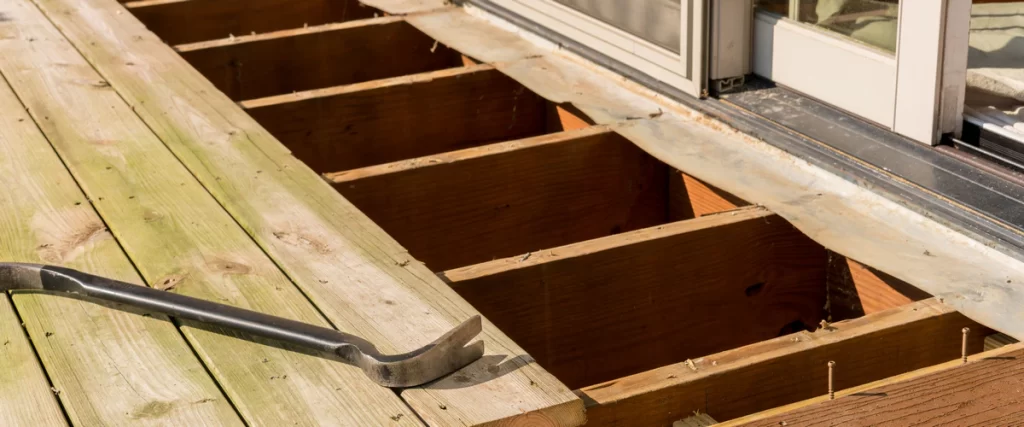
Why Deck Joist Span Matters
A joist is only as useful as its ability to carry a load without deflecting too much. Too much flex underfoot doesn’t just feel wrong; it can crack your decking material, loosen fasteners, and compromise the whole deck frame over time.
The span is the distance a joist travels unsupported between a beam or ledger board. The longer the unsupported distance is, the more likely the joist will bend.
Deeper joists resist that bending better, which is why a 2×10 can span farther than a 2×8 under the same conditions.
How to Read a Deck Joist Span Chart
A span table cross-references three things: joist size, joist spacing, and species group. The result is the maximum allowable span for that combination.
Most residential decks use 16″ or 24″ on-center spacing, and the IRC organizes common lumber into three species groups:
- Southern Pine
- Douglas Fir-Larch, Hem-Fir, Spruce-Pine-Fir (SPF)
- Redwood, Western Cedars, Ponderosa Pine, Red Pine
Here’s a reference table based on 2021 IRC Table R507.6 (40 psf live load, 10 psf dead load, No. 2 grade with wet service factor included):
| Joist Size | Species Group | 12″ OC | 16″ OC | 24″ OC |
| 2×6 | Southern Pine | 9’11” | 9’0″ | 7’7″ |
| 2×8 | Southern Pine | 13’1″ | 11’10” | 9’8″ |
| 2×10 | Southern Pine | 16’2″ | 14’0″ | 11’5″ |
| 2×12 | Southern Pine | 18’0″ | 16’6″ | 13’6″ |
| 2×6 | Doug Fir / Hem-Fir / SPF | 9’6″ | 8’4″ | 6’10” |
| 2×8 | Doug Fir / Hem-Fir / SPF | 12’6″ | 11’1″ | 9’1″ |
| 2×10 | Doug Fir / Hem-Fir / SPF | 15’8″ | 13’7″ | 11’1″ |
| 2×12 | Doug Fir / Hem-Fir / SPF | 18’0″ | 15’9″ | 12’10” |
| 2×6 | Redwood / W. Cedars / Ponderosa / Red Pine | 8’10” | 8’0″ | 6’10” |
| 2×8 | Redwood / W. Cedars / Ponderosa / Red Pine | 11’8″ | 10’7″ | 8’8″ |
| 2×10 | Redwood / W. Cedars / Ponderosa / Red Pine | 14’11” | 13’0″ | 10’7″ |
| 2×12 | Redwood / W. Cedars / Ponderosa / Red Pine | 17’5″ | 15’1″ | 12’4″ |
Always verify compliance with your local building codes and confirm requirements with your local building official, as regional amendments are common.
What Changes the Maximum Joist Spacing
Span isn’t the only variable at play. A few factors significantly push the maximum allowable spans up or down.
Decking Material on Top
Composite decking is heavier than most wood species, which adds to the dead load your joists carry. Some composite manufacturers require tighter deck joist spacing, sometimes 12″ on center instead of 16″, to prevent excessive flex.
Always check the installation instructions from your decking manufacturer before finalizing your layout.
Wet Service Factor
If joists will be exposed to repeated moisture, standard dry-service values don’t apply.
The wet service factor reduces the allowable spans, and in some cases, you’ll need to go up a nominal depth to compensate.
Includes Incising Factor
Certain pressure-treated lumber, especially for ground contact or wet conditions, undergoes an incising process that slightly reduces its structural values.
When a span table note says “includes incising factor,” those values already account for it. If you’re working from a table that doesn’t, you’ll need to apply that adjustment manually.
Cantilever Length
A cantilever is the portion of a joist that extends beyond the last supporting beam. Most codes limit this to one-quarter of the joist’s back span.
Exceeding that without engineering review is a quick way to end up with a springy, code-failing deck.

Joist Hangers, Blocking, and Ledger Connections
You can have perfect joist sizing and still end up with a weak frame if the connections are sloppy.
Joist hangers need to match the joist depth exactly and be installed with the correct nails, not whatever happens to be on the workbench. Using undersized nails or skipping nail holes defeats the load path entirely.
The American Wood Council publishes detailed guidance on connection design for wood framing that’s worth bookmarking if you’re going deep on this.
Blocking between joists at midspan reduces lateral movement and is often required by code once you exceed a certain joist depth or span. It also helps with crown control if your lumber isn’t perfectly straight.
The ledger board connection to the house is arguably the most important detail in the whole deck. It needs proper flashing, the right fastener pattern, and must attach to the structural framing of the house, not just the sheathing.
Species-Specific Notes Worth Knowing
Not all lumber at your local yard is labeled clearly. A few things to keep in mind:
- Douglas Fir-Larch, Hem-Fir, and Spruce-Pine-Fir all share the same span values in the IRC table. They perform similarly enough that the code treats them as one group, though you’ll still want to confirm what species you’re actually purchasing.
- Redwood and western cedars are beautiful and rot-resistant, but they fall into the lowest-performing species group in the IRC table. A 2×10 in this group at 16″ OC tops out at 13’0″, compared to 14’0″ for Southern Pine at the same spacing.
- Ponderosa pine and red pine are grouped with redwood and western cedars in the IRC, so they carry the same shorter allowable spans. If you’re using either of these in a long-span application, plan accordingly.
The IRC (International Residential Code) span tables, available on the ICC’s website, are a reliable baseline. That said, always confirm with your local building official, as local amendments are common.
If you’re curious about how all of this fits into a full deck build from the ground up, the deck-building process at Decks on Point walks through each stage clearly.
Deck Joist Span Chart: Putting It All Together
When you’re planning a deck, work backwards from what you know: the species available locally, the decking material you’ve chosen, and the load requirements in your area.
From there, the deck joist span chart tells you what size joist you need at what spacing, and how far you can push each span before adding a beam.
It’s a lot of variables, and one missed adjustment, whether it’s the wet service factor or the cantilever limit, can mean a failed inspection or a deck that doesn’t perform the way it should over time.
Deck Joist Span Chart and Spacing FAQs
What is the maximum joist span for a 2×10? It depends on the species group and spacing. Per the 2021 IRC, Southern Pine at 16″ on center can span up to 14’0″, while Douglas Fir-Larch, Hem-Fir, and SPF at the same spacing max out at 13’7″. Tighten to 12″ on center and Southern Pine reaches 16’2″. Redwood and western cedars at 16″ OC top out at 13’0″. Always cross-reference the full table for your specific species and load conditions.
Does deck joist spacing affect composite decking? Yes, quite a bit. Many composite decking brands require 12″ on-center spacing for diagonal installations or in climates with temperature swings. Check your specific product’s installation instructions before setting your layout.
Can I use a 2×6 joist for a deck? You can, for shorter spans and tighter spacing. A 2×6 in Douglas fir at 12″ on center can handle spans approaching 10 feet, but for most standard decks, 2×8 or 2×10 gives you more flexibility.
What’s the difference between live load and dead load for decks? Live load is the weight of people and furniture, typically 40 psf for residential decks. Dead load covers the weight of the deck structure itself, usually 10 to 15 psf. Both factors into your allowable joist spans.
Honestly, It’s a Lot to Keep Track Of
Between species groups, spacing requirements, load calculations, cantilever rules, and local code variations, joist planning can become a surprisingly involved process. Most homeowners who start down this road end up wishing they’d just called a professional from the beginning.
If that’s where you’re landing, the team at Decks on Point handles all of this on your behalf, from span calculations to permit-ready plans to the finished build.
Call us at (317) 903-2431 or message us here, and let’s talk through what your deck needs.