
Most Indiana homeowners pay between $25 and $45 per square foot for composite decking, fully installed. On a 300-square-foot deck, that lands somewhere between $7,500 and $13,500. Higher-end composite decking brands and larger deck designs push that higher.
Everything below explains why your number might be different.
The Price Starts With the Board Itself
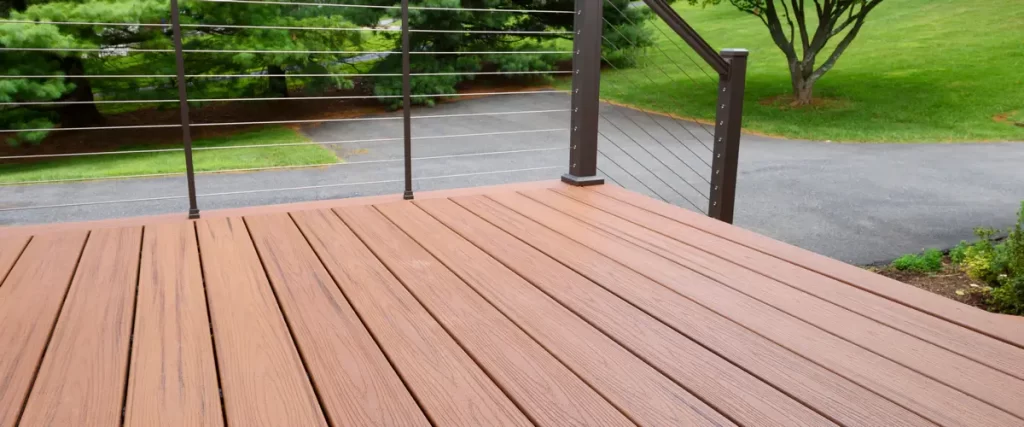
Composite decking boards are not all priced the same. There are three general tiers, and the gap between them is real.
- Entry-level composite: $3 to $6 per linear foot. Gets the job done, less texture, shorter warranty, usually no capping on the sides
- Mid-range composite: $6 to $10 per linear foot. Better fade and stain resistance, more realistic wood grain, most popular choice for Indiana homeowners
- Premium composite decking: $10 to $16 per linear foot. Full capping, longer warranties, noticeably better performance in intense sun and Indiana’s freeze-thaw seasons
Trex decking sits comfortably in the mid-to-premium range and tends to be one of the more requested brands around here. That said, composite decking brands vary widely in quality even within the same tier, so the brand conversation matters less than understanding what each price point actually buys you.
What Indiana Labor Costs Look Like Right Now
Material cost is only part of the picture. Labor costs for deck building in Indiana typically run between $8 and $15 per square foot, and several factors move that number.
Deck size matters, but so does deck design. A simple rectangular deck off the back door is faster to build than a multi-level layout with built-in features, hidden fasteners, and custom railing. Complexity adds hours, and hours add to total cost.
Access to your yard plays a role too. Tight side gates, sloped ground, or a second-story installation all affect how long the job takes.
| Deck Size | Material Cost (Mid-Range) | Labor Estimate | Total Range |
| 200 sq ft | $1,600 to $2,400 | $1,600 to $3,000 | $3,200 to $5,400 |
| 300 sq ft | $2,400 to $3,600 | $2,400 to $4,500 | $4,800 to $8,100 |
| 400 sq ft | $3,200 to $4,800 | $3,200 to $6,000 | $6,400 to $10,800 |
| 500 sq ft | $4,000 to $6,000 | $4,000 to $7,500 | $8,000 to $13,500 |
These are honest ranges, not best-case scenarios.
The Costs People Forget to Budget For
A building permit is required for most new deck projects in Indiana. Indiana’s residential building codes cover outdoor structures, and skipping this step creates real problems when you sell the home. Permit fees typically run between $100 and $500 depending on your municipality.
A few other things worth factoring in:
- Railing systems can add $150 to $600 per linear foot depending on material and style
- Framing and substructure work, if the existing deck frame needs replacement, adds significant cost that’s separate from the decking material cost
- Removal of old deck boards from an existing deck runs $500 to $1,500 for most jobs
If a contractor’s quote doesn’t mention any of these, ask about them directly before you sign.
Is Composite Actually Worth It Over Cedar or Real Wood?
Cedar and natural wood decking cost less upfront. That part is true. But ongoing maintenance, including staining every 2 to 3 years, repairs from rotting or warping, and eventual board replacement, adds up across a decade in ways that make the initial savings feel smaller.
Composite decking’s low maintenance profile is where the long-term math shifts. No staining. No sealing. Minimal maintenance beyond occasional cleaning. Many homeowners find the total cost of ownership over 15 years is comparable to wood, and they get superior durability with none of the seasonal upkeep.
Indiana’s summers can bring intense sun and humidity, and winters bring freeze-thaw cycles that punish traditional wood decking. Composite materials hold up through all of it without warping or cracking the way real wood does.
A Few Questions That Come Up a Lot

Does partial shade affect which composite I should choose? Actually yes. Some composite decking gets noticeably hot in full sun. If your deck sits in partial shade most of the day, you have more flexibility. If it bakes in afternoon heat, look for boards specifically rated for heat resistance.
Can composite be installed over an existing deck frame? Sometimes. A contractor needs to assess whether the existing substructure is sound. If it is, you save money on framing. If it isn’t, replace it now rather than later.
Are recycled materials in composite decking a quality concern? Most composite boards today use recycled materials including reclaimed plastic and wood fiber. The manufacturing process matters more than the recycled content percentage. Reputable composite decking brands test their boards thoroughly regardless of material origin.
Honestly? Let Us Just Figure This Out for You
Reading through all of this gives you a solid base, but every outdoor space is different. The cheapest bid rarely tells the full story, and the right composite decking choice for your yard depends on things a blog can’t see.
Take a look at ourcomposite decking services to get a sense of what we do, then call us at (317) 903-2431 or message us here and we’ll work through the specifics together.